Sterile compounding education
Individual aseptic practice at 25 four-foot workstations, supported by instruction, feedback, observation, and competency assessment for pharmacy learners.
Core foundationAdvancing medication safety through education, research, and practice. A proposed institute for future pharmacists and working professionals, with individual skills stations, functional cleanrooms, and studios that extend learning beyond Tyler.
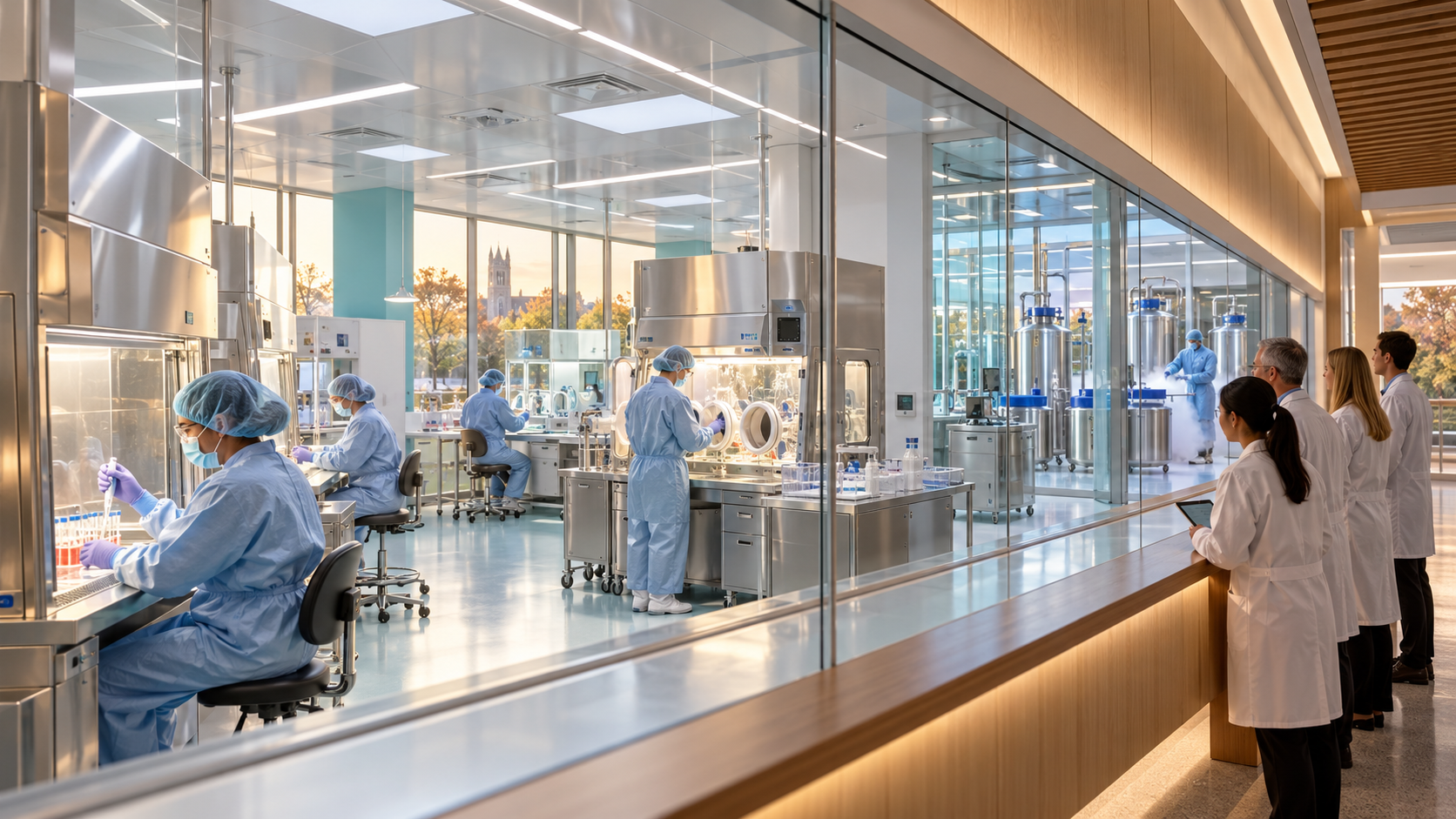 Illustrative concept visualization · not an existing facility
Build a place where rigorous sterile practice becomes a platform for discovery, workforce preparation, and responsible translation of advanced medicines.
Sterile compounding provides the practical foundation. The Institute would connect pharmacists, technicians, scientists, engineers, clinicians, and learners to improve preparation, quality, handling, delivery, and access.
Explore the proposed capabilities by stage. The core builds enduring teaching and research capacity; specialized clinical and manufacturing activities require separate authorization and operational readiness.
Individual aseptic practice at 25 four-foot workstations, supported by instruction, feedback, observation, and competency assessment for pharmacy learners.
Core foundationTeach containment, exposure prevention, device selection, spill response, decontamination, and safe handling across pharmacy and patient-care workflows.
Core foundationStudy preparation challenges involving parenteral nutrition, pediatric and neonatal dosing, ophthalmics, preservative-free preparations, and delivery devices.
Core foundationInvestigate aseptic workflow, contamination control, human factors, environmental monitoring, stability questions, automation, and medication-use systems.
Core foundationDevelop education and research in chain of identity and custody, time-critical receipt, cryogenic storage, thawing, preparation simulation, and clinical handoffs.
Build toward radiopharmaceutical education, quality control, shielded manipulation, and targeted diagnostic / therapeutic workflows with radiation-safety partners.
Evaluate on-site isotope production only if regional need, distribution economics, partners, licensing, staffing, and lifecycle costs support a viable case.
Long-horizon optionExplore how decision support, micro-batches, automation, and individualized data could shape future preparation—under validated processes and human governance.
Research horizonCore programs for practitioners: advanced cleanroom intensives, designated-person development, assessment and remediation, train-the-trainer education, and institutional digital learning.
Core foundationUse one connected workflow to teach the thinking, controls, and handoffs behind complex medicines—not just the manipulations at the workbench.
Clarify the need, order, source, product status, and time constraints.
Confirm identity, custody, temperature, integrity, and appropriate storage.
Use the right environment, equipment, people, calculations, and documentation.
Apply independent checks, quality evidence, traceability, and escalation pathways.
Debrief, study performance, and turn insight into safer practice.
The Institute would connect classroom learning, repeated hands-on practice, realistic simulation, structured feedback, and later reassessment. It builds on existing pharmacy education by deepening integration, transfer, judgment, and retention.
Layer knowledge and practice across the learner’s development rather than treating aseptic technique as a one-time lab.
Scenarios can test decisions that are difficult to teach through demonstration alone: interruptions, discrepancies, suspected contamination, equipment failure, exposure concerns, and uncertain handoffs.
Use multiple forms of evidence to provide specific feedback and document progress. Course completion is educational evidence; it does not replace an employer’s required qualification, authorization, or competency program.
Begin with feasible questions in the instructional environment, then test useful changes with practice partners where approvals and data governance permit.
Small-group cleanroom intensives for practicing pharmacists and technicians, with preparatory modules, coached exercises, individual assessment, remediation, and later reassessment.
Overhead and oblique camera views, live switching, recording, instructor audio, captions, and secure review connect the lab with learners beyond campus.
The initial program includes the individual skills lab, functioning classified suite, classrooms, studios, and research support. The earlier 12,000–16,500 NSF core estimate must be reprogrammed against this expanded scope; a new total has not been established.
A nonclassified instructional lab with 25 nominal four-foot horizontal LAFWs and one instructor demonstration cabinet. Every simultaneous learner has a dedicated position.
Three six-foot horizontal LAFWs in a nonhazardous buffer room and three Class II BSCs in a separate hazardous buffer room. Ante/garbing, monitored HVAC, appropriate exhaust, certification, cleaning, and service access are part of the initial program.
Flexible teaching, team cases, practitioner workshops, orientation, and post-exercise feedback beside the lab and cleanroom observation spaces.
Cleanable demonstration camera systems, instructor audio, live switching, recording, editing, and digital course production connect campus activity to regional and remote learners.
Process simulation, human factors, contamination control, environmental monitoring, and learning outcomes. Use qualified partners for specialized analytical work as the research portfolio grows.
Partner-supported handling education, identity and custody, time-critical logistics, simulation, and research. Dedicated cryogenic and process infrastructure follows defined funded scope and operational readiness.
Receiving and quarantine, released materials, cleaning and waste support, equipment staging, monitored utilities, IT, and maintenance access.
Use established partners for cell/gene therapy GMP manufacturing, regulated release testing, clinical radiopharmacy, and cyclotron production. Local expansion requires its own demand, operating, and capital case.
Start with a small number of measurable practice problems. Training transfer plus an exposure-prevention or human-factors pilot can build evidence for foundation, health-system, industry, and appropriately matched government support. Research priorities are proposals, not secured awards.
See the program briefCompare coached simulation with conventional instruction using blinded observation, delayed reassessment, and workplace performance.
Study cleaning, transfer devices, workflow, and training through contamination measurements with industrial-hygiene and analytical partners.
Test missed critical errors, false alerts, reviewer time, and agreement with experts across cabinets, camera views, and practitioner groups.
Reduce missed incubation readings, transcription errors, and documentation time while preserving traceability for media fills and environmental monitoring.
Compare syringe choice, dilution technique, gravimetry, and independent verification using measured preparation accuracy.
Evaluate cameras, balances, supply layouts, first-air protection, visibility, posture, and workflow errors.
Test studio-based preparation plus periodic hands-on learning for retained competence, implementation, and reduced travel burden.
Rehearse changes in concentrations, containers, suppliers, and preparation methods; measure accuracy and escalation.
Study identity, custody, thawing, transfers, timing, and handoffs with qualified partners and appropriately scoped materials.
Explore identity, dose, traceability, and reliable quality decisions for very small batches with engineering and analytical partners.
Make the first phase independently valuable, while protecting the option to grow into more specialized work as partnerships and resources mature.
Confirm governance, site, utilities, the revised room program, staffing, revenue allocation, prospective buyers, and full lifecycle costs.
Activate the 25 plus one teaching lab, six-cabinet functional suite, classrooms, studios, research support, and practitioner education with a funded operating plan.
Add dedicated cell-therapy readiness and radiopharmacy / theranostics capabilities when authorized and supported.
Proceed only if demand, partners, licensing, staffing, logistics, and lifecycle economics form a credible case.
IAEA facility guidance describes a dedicated vault and support block alongside production, QC, access, storage, and radioactive-waste functions. The selected accelerator and isotope portfolio drive the actual scope, so this deserves its own feasibility and business case.
Publicly described programs show that sterile-compounding education, cleanroom simulation, and professional training already exist elsewhere. UT Tyler’s opportunity is to connect them into a pharmacy-led platform that links instruction, observed competency, practice research, and a regional advanced-therapy network.
Distinctive capabilities that anchor the Institute and directly serve learners and regional workforce needs:
Capabilities that become stronger with clinical operations, research, and patient-care partners:
Use experienced facilities while UT Tyler establishes need, governance, expertise, and a sustainable operating case:
Beyond tuition, the goal is a diversified operating model that covers attributable staff, supplies, cleanroom operations, certification, technology, university overhead, and an equipment replacement reserve. No break-even date or revenue forecast has been established.
Annual hospital and health-system agreements, institutional digital licenses, and repeat practitioner programs provide the proposed operating foundation.
Scoped consulting, independent industry studies, competitive grants, and contracts support defined work. Restricted research funds cover allowable project costs rather than unrestricted operating profit.
Capital gifts, equipment partnerships, endowed support, and scholarships help build the facility, maintain access, and fund renewal. Equipment gifts reduce cost; they are not recurring cash income.
Validate buyer demand and delivery cost before expanding the service catalog.
Reserved learning seats, onboarding, advanced workshops, and bounded quality support under a renewable contract.
Small-group cleanroom programs with coached exercises, specific feedback, and performance assessment.
Documented observation, targeted coaching, and reassessment for employers, who retain qualification responsibilities.
Educator and designated-person programs with calibrated rubrics, teaching resources, and follow-up support.
Studio-produced demonstrations, decision cases, assessments, faculty guides, and updates for hospitals and schools.
Consulting and independent technology studies with clear scope, deliverables, staffing, and protected student teaching time.
Potential research routes include pharmacy foundations, health-system quality funding, independent industry contracts, NIOSH occupational-safety programs, and FDA regulatory-science solicitations. Program fit, eligibility, open dates, and allowable costs must be confirmed for each proposal. No funding commitment or agency endorsement is represented.
Updated October 16, 2026. The program, space/capital, equipment, and partnership briefs use the institute identity and the revised education, facility, research, and sustainability goals.
Mission, education pathways, research priorities, partner strategy, and the proposed financial sustainability model.
Reprogramming requirements for the 25-station lab, functional suite and studios, plus infrastructure, lifecycle costs, and decision gates.
The 25 individual four-foot LAFWs plus instructor, three six-foot LAFWs, three BSCs, studio integration, and manufacturer comparison.
A manufacturer discussion brief covering both cabinet packages, practitioner and student reach, studio integration, five-year support, and academic independence.
Start with a strong sterile-practice foundation. Bring the right partners together. Create room for discovery. Grow into advanced therapies when the science, need, and stewardship align.